 משלוח חינם לנקודת איסוף בכל הזמנה מעל ₪249






When awareness meets protection: our collaboration with the Israel Cancer Association
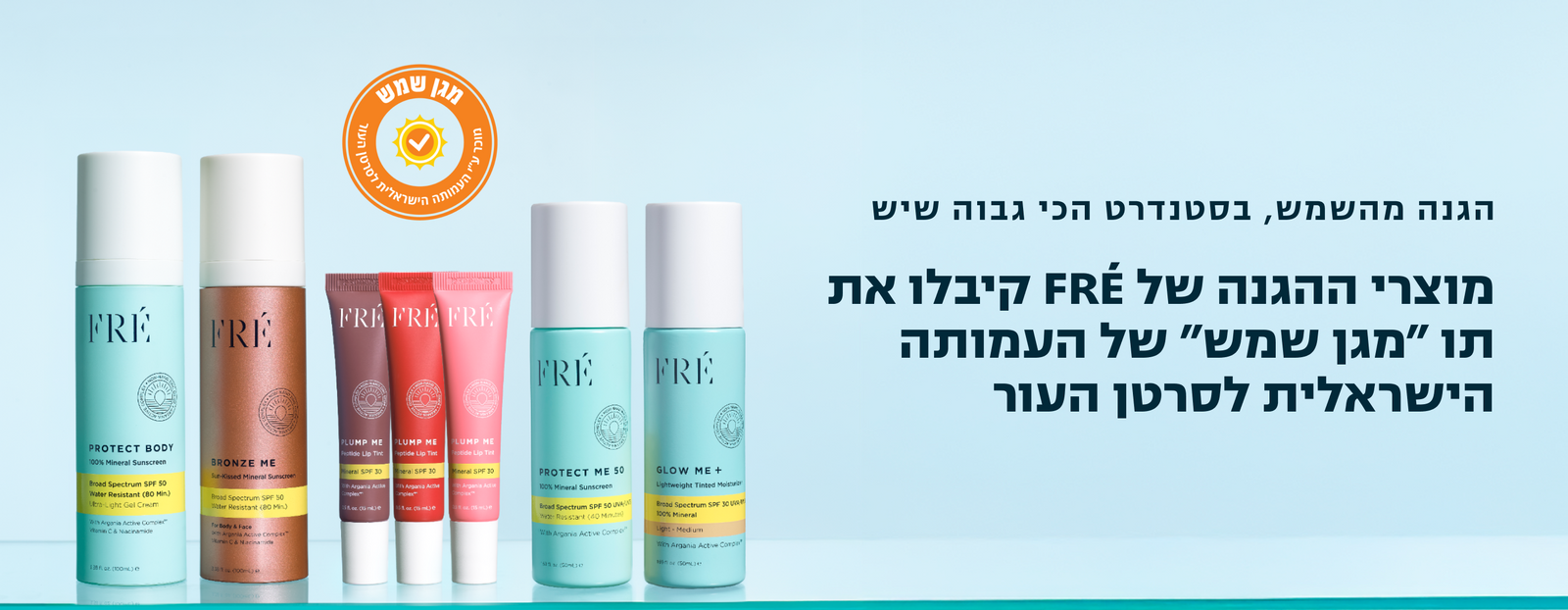

This coming April, we are launching a collaboration with the Israel Cancer Association—a move born out of a desire to delve deeper not only into what we put on our skin, but also into understanding what truly protects it. For us, this is not just a partnership, but a direct continuation of what we believe in: good skincare starts with the right knowledge. As part of this collaboration, our sun protection products have received the "Sun Shield" seal—a professional certification backed by scientific testing and guidance from experts in the field. This is not just a label, but a reinforcement that the choices we make—at the formula level as well—meet genuine professional standards.
Why is this even important?
To understand, you have to start with the basics: sun exposure is an inseparable part of our lives, especially here. But alongside the benefits, UV radiation is also one of the main factors for cumulative skin damage—the kind you don't always see immediately. Beyond premature aging, pigmentation, and loss of elasticity, this exposure can also affect health itself and, in some cases, lead to the development of skin cancer. It is a quiet, daily process that accumulates over time—and that is why protection also needs to be daily, not something reserved only for the beach or vacations.
This is where SPF comes into the picture. Many talk about it, but it isn't always clear how it actually works. Sunscreen does not completely "block" the sun; rather, it reduces the amount of radiation that penetrates the skin. When it comes to broad-spectrum protection, it refers to both UVB rays (which cause sunburns) and UVA rays—those that penetrate deeper into the skin, are responsible for premature aging, and are also considered a major factor in the development of skin cancer. Therefore, the difference between daily use and avoidance is not small—it is cumulative.
Mineral or chemical - and what is the difference?
But not every sunscreen works the same way. One of the most important distinctions is between chemical filters and mineral filters. Chemical filters work by absorbing radiation and converting it into heat within the skin, while mineral filters work on the surface of the skin, creating a physical protective layer that reflects and scatters radiation. This means not just a technical difference, but a difference in approach: immediate protection, without absorption into the bloodstream, with a higher safety profile. In fact, mineral filters are considered the safest and most effective option, and they are the only ones defined by the FDA as GRASE—generally recognized as safe and effective for use. They are the preferred choice for dermatologists, especially for sensitive skin, acne-prone skin, and populations at risk.
Protection that doesn't just protect - but also treats
FRÉ's sun protection products are based on non-nano zinc oxide—a broad-spectrum mineral filter that provides protection against both UVA and UVB rays. Unlike nano-sized particles, which do not always remain on the surface of the skin, these are particles that stay on the outer layer, creating an effective physical barrier. Additionally, our formulas incorporate active ingredients such as niacinamide, vitamin E, and antioxidants, which help strengthen the skin barrier and reduce oxidative stress—one of the main causes of premature aging.
But the protection doesn't end there. We believe in a broader approach—one that not only protects, but also repairs. The combination of a mineral filter and FRÉ's exclusive Argania Active Complex™ patent allows us not only to protect the skin during exposure, but also to support it before and after—neutralizing free radicals, maintaining moisture, and restoring the skin's balance and natural glow. This is the difference between a sun protection product and a complete skincare routine.
One of the most interesting developments in the field is the use of tinted mineral filters—like those containing iron oxides. Beyond protection from UVA and UVB rays, they also help block visible light, including blue light from screens, which is known to affect pigmentation and melasma. This is another example of how sun protection is becoming more precise, better adapted—and more relevant to our lives today.
Ultimately, all this knowledge converges into one simple point: sun protection is not a one-time act, but a habit. Not something you do when you remember, but something you choose—every day anew. The collaboration with the Israel Cancer Association is part of our commitment to continue talking about this, to deepen understanding, and to help more women make the right choice—not just for their skin today, but also for its future. Because sometimes, the biggest difference starts with the smallest action.
Leave a comment
Comments will be approved before showing up.